


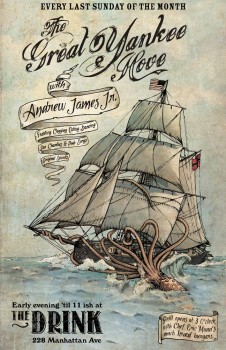

Troubadour Andy Friedman is playing this Saturday February 26, at Jalopy Theatre in Carroll Garden. He is currently promoting his upcoming release Laserbeams And Dreams, a collection of minimalist original songs. We caught up with Andy to ask him about the album, art, New York, and his progression from New Yorker editorial assistant to his current role as a prolific songwriter.
Brooklyn Country: I recently discovered you started out touring as a “Slideshow Poet”. How did you create that show and what sort of slides did you feature?
Andy Friedman: I came to performance not as a musician, but as a painter—a fine artist with a BFA in painting from the Rhode Island School of Design. I am an academically trained easel painter and all I ever wanted to be was the next Velazquez. My paintings and pencil drawings took months and in some cases years to make, and every hour would be spent listening to music in my headphones. And that started when I was a kid. So music, good songs, records, and the liner note experience was always a part of my life, and with the slideshow I was only trying to incorporate that aspect of the music experience into the art experience. I toured the coffeehouses, rock clubs, colleges, and museum theaters across the nation accompanying projections of my paintings, drawings, and Polaroid photos with a kind of poetry reading–essentially the lyrics to my images.
BC: How did you make the transition as a singer-songwriter in the performance arena?
AF: I did this (touring slideshow) for about three years until I heard the Hank Williams as “Luke The Drifter” recordings and decided that my readings could use a little music to go with it, and so I began to travel with a band, which eventually encouraged me to learn a few chords on guitar and strum along with the music. The spring of 2005 was the first time I ever picked up a guitar in my life. And then I slowly started singing my poems, and after a little while someone mentioned that the images were distracting the attention that should go to the songs. Until that point I didn’t realize I was writing and singing songs, but that’s how it evolved. I sort of fooled myself into it and never looked back.
BC: With Laserbeams And Dreams, you recorded a majority of the album in a 24-hour period in your apartment. Why this approach?
AF: It’s not what we set out to do. I booked three days and nights in the home studio of Jen Chapin and Stephan Crump, who live down the block from me. The guitarist and producer David Goodrich came down from Western Massachusetts to oversee production and lend guitar. Our plan was to lay down the basic tracks and then start inviting musicians in to overdub additional parts. We spent the first day adjusting the mics and getting a basic room sound, and by that night messed around with one or two takes of maybe one or two songs. From that point, magic just happened and we all knew it. We locked the doors, no one came in or out, and by around 3 am the second day we had it all. We listened until dawn and then all day the third day. Most of the tracks on Laserbeams And Dreams are the first take, the take when I was merely demonstrating the songs to Stephan (bass) and Goody (guitar) — who had yet to hear any of these songs — and decided to keep the tape rolling. We felt we just couldn’t make a record like that if we tried, or planned to do it that way. It just happened, and we were so mesmerized with the playback that we decided to just release it without touching a thing. We did not mix this album. It just is.
BC: If you had to hand off the five most influential pieces of art -the pieces that have helped define your artistic style- what would they be?
AF: I fashion my life and art up to this point around, without a doubt, the economy and honesty in the paintings (and the life) of the artist Andrew Wyeth, the conviction and passion in the paintings of the European Baroque artists of the 15th and 16th Centuries, the surprise in the songwriting of the basic food groups of the 1960′s and 1970′s singer-songwriter era (Joni Mitchell, Jackson Browne, Randy Newman, Bruce Springsteen, Tom Waits, Willie Nelson, and Bob Dylan) and all laced with the quiet confidence of Robert Redford’s portrayal of Roy Hobbs in “The Natural” and the vengefulness of RoboCop.
BC: How has New York played a role in your career as a musician?
AF: New York is a city of opportunity. When I first moved here out of college and was looking for a job, I found one immediately through word of mouth, helping out a farmer at his flower stand in Union Square’s Farmer’s Market three days a week for cash. From there I was offered a job as an “editorial assistant” at The New Yorker magazine, and this was facilitated through the combined efforts of a friend of mine from RISD who was already working there and through the help of my former painting professor and mentor at RISD, the illustrator Richard Merkin, who appears on the cover of The Beatles’ Sgt. Pepper’s album — he’s the one on the top row tipping his purple top hat. Once I was there, the door opened for me to contribute drawings and gag cartoons to the magazine, and once that started happening other magazines began calling. It’s just how New York City works. There’s a real fabric here. And when it came time to find a pedal steel player for my poetry band I had my choice of dozens recommended by various friends. My friends from Virginia or Alabama would tell me that there was basically one pedal steel player in each town, and couldn’t believe the resources that surrounded this city. That’s what happens when you live in a place with millions of people. For the most part, everyone just sort of works together and leans on one another. Or, at least, that’s the idea.
Andy Freidman’s new CD Laserbeams And Dreams will be celebrated at a release on Saturday, March 12 at Southpaw in Brooklyn. Advanced tickets are encouraged.

